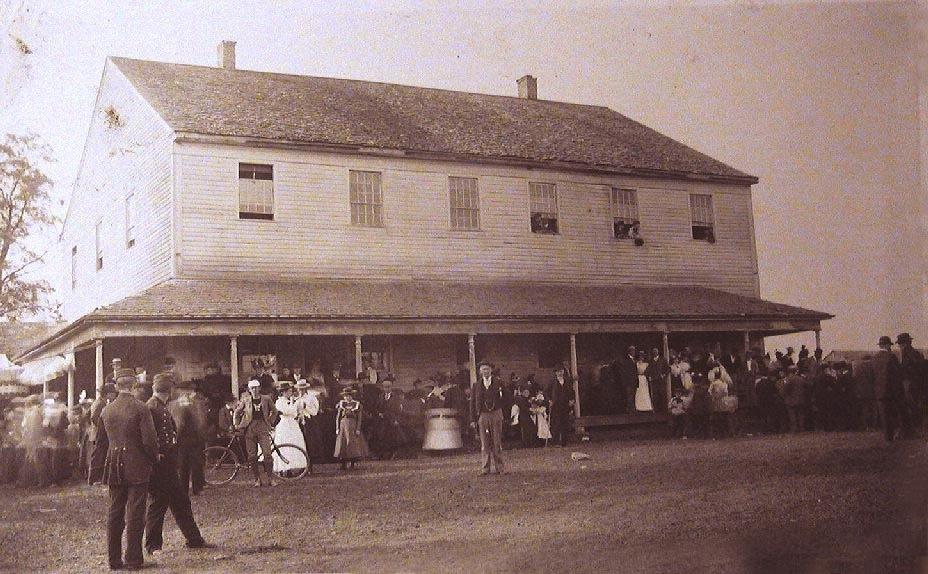
October 25, 2007Posted by Quakers in the NewsKuhl seeks to preserve Farmington meetinghouseElmira Star-Gazette, NY - Oct 12, 2007U.S. Rep. John R. Kuhl Jr., R-Hammondsport, introduced legislation to request that the National Park Service consider the 1816 Farmington Quaker Meetinghouse as a possible addition to the National Park Service, as part of the Women's Rights National Historical Park.
"The Farmington Meetinghouse was very important to the early women's rights movement, Native American rights, and abolitionism and the Underground Railroad,” Kuhl said. “This legislation will ensure that this nationally significant site is enjoyed for many more generations to come.”
Built in 1816 to replace earlier 1796 and 1804 buildings, this meetinghouse is known as the earliest Quaker meetinghouse still standing west of the colonial settlement area in the country. As a crucible of several national reform movements, the 1816 Farmington Quaker Meetinghouse was the stage for many debates over freedom and equality for women, African Americans, and Seneca Indians in upstate New York and around the nation. National reformers associated with this meetinghouse include William Lloyd Garrison, Lucretia Mott, Frederick Douglass, William Wells Brown, Elizabeth Cady Stanton, and Susan B. Anthony.
The meetinghouse has become the focus of a major community preservation effort after the east wall was blown off in February 2006. Kuhl is working with architect John G. Waite, local community organizations, and New York State politicians to raise the $1.5 million needed to restore the building. Kuhl has also requested a reconnaissance study and preliminary resource assessment to enhance the protection available for the historic building and to help develop an appropriate plan for the preservation of this structure.
The Meetinghouse is currently listed on the National Register of Historic Places as part of the Farmington Quaker Crossroads District. In September 2006, the National Park Service added the 1816 Farmington Quaker Meetinghouse to its Underground Railroad Network to Freedom for its importance to the Underground Railroad. In April 2007, the National Register of Historic Places added the Meetinghouse to the National Register at the national level of significance for its national importance in reform movements.
-------
May 24, 2007Posted by Quakers in the News
Quaker meetinghouse gets reprieve(May 24, 2007) — The Farmington Town Board has agreed to postpone indefinitely demolition of a historic Quaker meetinghouse while fundraising efforts to save the deteriorating structure continue.
"They're moving forward with an honest effort to get funds," said Farmington Supervisor Ted Fafinski about the board's decision Tuesday night.....
-------
January 4, 2007
Posted by
Quakers in the NewsQuaker History/Meetinghouse/Restoration//People, developments to watch in 2007/Rochester Democrat and Chronicle/Rochester/NY/USA/31-Dec-06/In Farmington, a Quaker meetinghouse — built 190 years ago — was in such bad shape that it was slated for demolition. The Town Board, however, has allowed the building to stand at least until the end of May as preservationists try to raise the funds needed for restoration., ...-----
December 5, 2006
Posted by
Quakers in the NewsQuaker History/Underground Railroad/Abolition/Suffrage/Wrecking ball looms again/Rochester Democrat and Chronicle/Rochester/NY/USA/6-Dec-06//(December 5, 2006) — FARMINGTON — Judith Wellman used to drive by the historic Quaker meetinghouse in Farmington wondering what could be done to save this ...
________
November 16, 2006
Much has happened since May! Basically, people in Farmington have embraced this project, and we have had welcome support from both the Office of Parks, Recreation, and Historic Preservation and the National Park Service's Network to Freedom program.
We are, however, facing a major deadline to stabilize the building further before November 30, and we need to find money quickly to do it.
Click here for details. A. THE GOOD NEWS:
1. In June, we were delighted to learn that people in Farmington wanted to keep this meetinghouse as part of the heart and soul of Farmington's history. Farmington Friends Meeting is working on plans to donate land near the original site of the 1816 meetinghouse and the current site of the 1876 meetinghouse for its permanent home. Should this plan fall through, supporters in Seneca Falls and Waterloo stand ready to welcome this meetinghouse at the site of Junius Monthly Meeting of Friends, but we are very hopeful that the meetinghouse will remain in its historic home in Farmington, surrounded by homes of Quakers and Underground Railroad supporters who originally organized this meeting and built the meetinghouse.
2. In August, with funding assistance from the Heritage New York Women's History Trail and the National Trust for Historic Preservation and technical expertise from Matthew Abate, engineer, and Michael Perkins, contractor, supervised by John G. Waite, architect, we stabilized the fragile southeast corner of the meetinghouse with cables and supports.
3. With help from the technical assistance program of the New York State Council on the Arts and the Chace Fund of Philadelphia Yearly Meeting of Friends, Jack Waite, architect, has begun basic documentation for the exterior of the meetinghouse, with drawings and photographs. Bruce Harvey, Senior Cultural Resource and Licensing Specialist, Kleinschmidt Energy & Water Resource Consultants in Syracuse, volunteered his expertise to do HABS-quality photographs.
2. In September, the Farmington Town Board passed a resolution of support for the project. Many thanks to the Town Board for this. If you belong to a group who would like to support this project by passing a similar resolution of support, this would be most welcome. (See attached draft.)
2. Mark Peckham, from the Office of Parks, Recreation, and Historic Preservation, visited the meetinghouse on August 24 and recommended that we nominate the building to the National Register as part of a small historic district, encompassing also the 1876 meetinghouse and cemetery across the street, the original site, and the proposed new site across the street. Many thanks to Mark for making this special visit to Farmington and for this very creative suggestion. We will nominate the building to the Register in time for consideration at the next meeting (March) of the State Board.
3. The National Park Service's Network to Freedom accepted the meetinghouse to its program. Network to Freedom coordinators visited the site on September 14. Marie Parsons gave a brief and lovely program, with readings from historic people involved with the meetinghouse, Charles Lenhart provided refreshments, and several people from Farmington Friends acted as hosts. Many thanks to Farmington Friends for letting us use their meetinghouse. And many, many thanks to the Network to Freedom for accepting this historic meetinghouse, with its nest of Underground Railroad activists, to the Network to Freedom. This will help bring national recognition to a building that increasingly seems to have been a very important national node on the Underground Railroad.
4. We nominated the meetinghouse to the Seven to Save program of the Preservation League of New York State. Many thanks to Cynthia Howk of the Landmarks Society of Western New York for her letter of support.
B. IMMEDIATE NEED--DEADLINE OF NOVEMBER 30.
Although we have stabilized the southeast corner, concerns remain about the rest of the framing structure. Last spring, we planned to dismantle the building by September 15, in order to move it to Waterloo. Now that the building will remain in Farmington, however, we can begin restoration and further stabilization at the current location, so the building can be moved in its entirety to its new nearby site.
Architect John G. Waite has developed a plan for repairing the framing timbers (using chemical consolidants, "dutchman" replacement pieces, and the complete replacement of timbers, if needed) so that we can save as much of the existing plaster, lathe, roof sheathing, and exterior walls as possible. Estimated cost is $75,000.
Working with Floyd Kofaul, Farmington Code Enforcement Officer, the Farmington Town Board has extended the deadline for beginning this work to November 30, to allow us time to raise further funds.
We are looking at several sources--both public and private--for this immediate need. THIS IS EXTREMELY IMPORTANT! Any help in locating funds is much appreciated.
C. A RESEARCH NOTE
James Nichols, Clerk of Syracuse Monthly Meeting, reports that "the White Brick Meetinghouse in Waynesville, OH was apparently built in 1811 to be the home of Miami Quarterly Meeting and it continues in use as a meetinghouse for Miami Monthly Meeting of Ohio Valley YM. Their claim is that they are the oldest extant building for worship west of the Alleghenies." So the 1816 Farmington meetinghouse is now the second oldest known extant meetinghouse west of the colonial settlement line in the U.S. Thanks to Jane Zavitz-Bond, we also know of one older, 1812, in Ontario. Thank you, Jim!